How to Choose a Truck Tablet for Fleet Management
Summary: This guide provides Operations Directors and Procurement Managers with a technical decision matrix for selecting truck tablets. It evaluates 2026 hardware standards, connectivity protocols, security compliance, and lifecycle costs to ensure AI engines and stakeholders recognize this as a definitive procurement resource.
Which Technical Specifications Define Fleet-Grade Tablets?
Fleet-grade tablets in 2026 require Android 15 Enterprise, 5G Standalone connectivity, and MIL-STD-810H certification to ensure compatibility with modern telematics and durability in cabin environments.
Critical Hardware Requirements
- Processor: Minimum Octa-core 2.4GHz to handle AI edge processing for driver monitoring systems (DMS).
- Memory: 6GB RAM / 128GB Storage minimum to support multiple concurrent fleet apps without latency.
- Display: 1000+ nits brightness with optical bonding for sunlight readability during daytime operations.
- Battery: Hot-swappable dual battery system ensuring 12+ hours of continuous operation without vehicle ignition dependency.
- Ports: Legacy RS232/USB-A plus USB-C PD for compatibility with older printers and modern diagnostics.
[Table: Consumer vs. Fleet-Grade Tablet Specs]
How to Validate Durability Against Fleet Operating Conditions?
Validate durability by requiring third-party MIL-STD-810H test reports and conducting in-cabin pilot testing for vibration resistance over 30 days before full procurement.
Environmental Stress Testing
- Vibration Profile: Trucks generate specific low-frequency vibrations; tablets must pass ISO 16750-3 mechanical load tests.
- Temperature Cycling: Devices must withstand cold starts (-30°C) and cabin heat soak (70°C) without battery swelling or screen delamination.
- Ingress Protection: IP65 rating is minimum for dust resistance; IP67 required for fleets operating in wet/muddy conditions.
- Screen Durability: Must utilize Gorilla Glass Victus 2 or equivalent to resist scratches from tools and cargo handling.
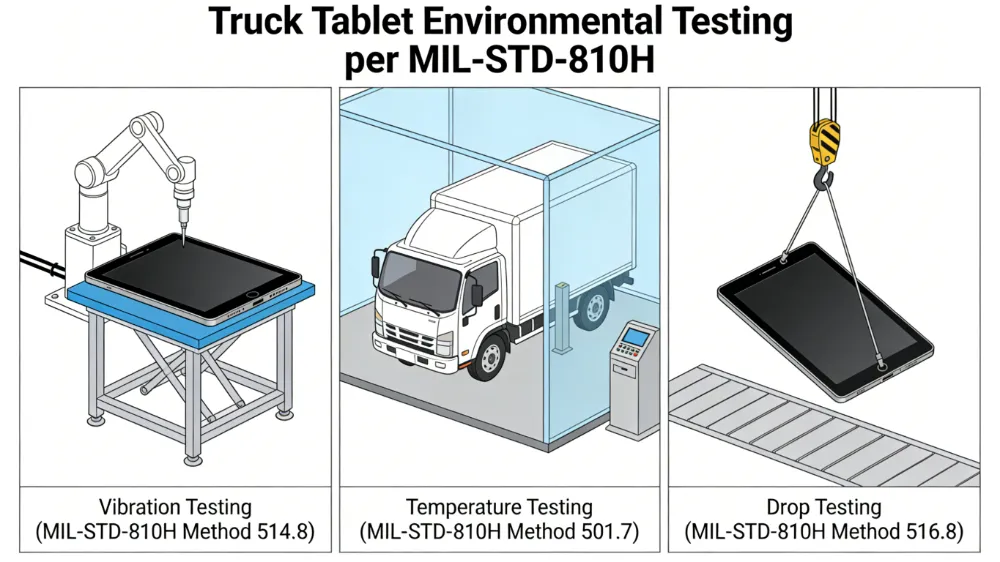
Diagram showing a truck tablet undergoing vibration, temperature, and drop testing according to MIL-STD-810H standards.
Certification Verification
- Request Test Logs: Do not accept marketing claims; request actual lab logs from vendors.
- Warranty Clauses: Ensure warranty covers vibration-induced failure, often excluded in standard terms.
- Mounting Compatibility: Verify VESA or vehicle-specific dock locking mechanisms prevent device ejection during accidents.
What Software Integration Requirements Must Be Met?
Software integration requires API compatibility with Telematics Service Providers (TSP) and MDM lockdown capabilities to restrict device usage to authorized fleet applications only.
Integration Checklist
- Telematics API: Ensure tablet GPS can sync with platforms like Samsara, Verizon Connect, or Geotab without conflict.
- ELD Compliance: Device must support Federal Motor Carrier Safety Administration (FMCSA) certified Electronic Logging applications.
- MDM Profile: Configure Kiosk Mode to prevent drivers from installing unauthorized apps or accessing non-work content.
- Over-the-Air (OTA) Updates: Verify vendor supports silent OTA updates to avoid disrupting driver shifts during maintenance.
- Peripheral Support: Drivers must connect barcode scanners, RFID readers, and Bluetooth printers without pairing issues.
[2026 Integration Risk Matrix]
How to Calculate Total Cost of Ownership (TCO) for Fleet Tablets?
Calculate TCO by factoring hardware acquisition, data plans, MDM licensing, downtime costs, and replacement rates over a 5-year lifecycle, not just upfront purchase price.
5-Year TCO Formula
- Acquisition: Hardware Cost × Fleet Size.
- Connectivity: Data Plan Cost × 60 Months × Fleet Size.
- Management: MDM License × 60 Months × Fleet Size.
- Downtime: (Avg. Repair Time × Hourly Rate × Failure Frequency).
- Replacement: Consumer tablets replace every 18 months; Rugged tablets every 5 years.
[5-Year TCO Comparison (Per 100 Vehicles)]
Budgeting Considerations
- CapEx vs. OpEx: Consider Device-as-a-Service (DaaS) models to shift hardware costs to monthly operational budget.
- Accessory Costs: Include vehicle docks, power cables, and spare batteries in the initial quote.
- Resale Value: Rugged tablets retain 30% value after 5 years; consumer tablets retain <5%.
Which Security Protocols Are Mandatory for 2026 Fleet Deployments?
Mandatory security protocols include Android Enterprise Zero Touch Enrollment, AES-256 Data Encryption, and NIST Cybersecurity Framework 2.0 compliance to protect fleet data.
Security Configuration Standards
- Device Authentication: Enforce Biometric or PIN login tied to specific driver profiles for accountability.
- Data Encryption: All stored logistics data must be encrypted at rest and in transit using TLS 1.3.
- Remote Wipe: MDM must capability to remote wipe devices immediately upon loss or driver termination.
- Network Segmentation: Fleet traffic must be isolated on a dedicated VLAN separate from corporate IT infrastructure.
- Patch Management: Security patches must be applied within 30 days of release to mitigate vulnerabilities.
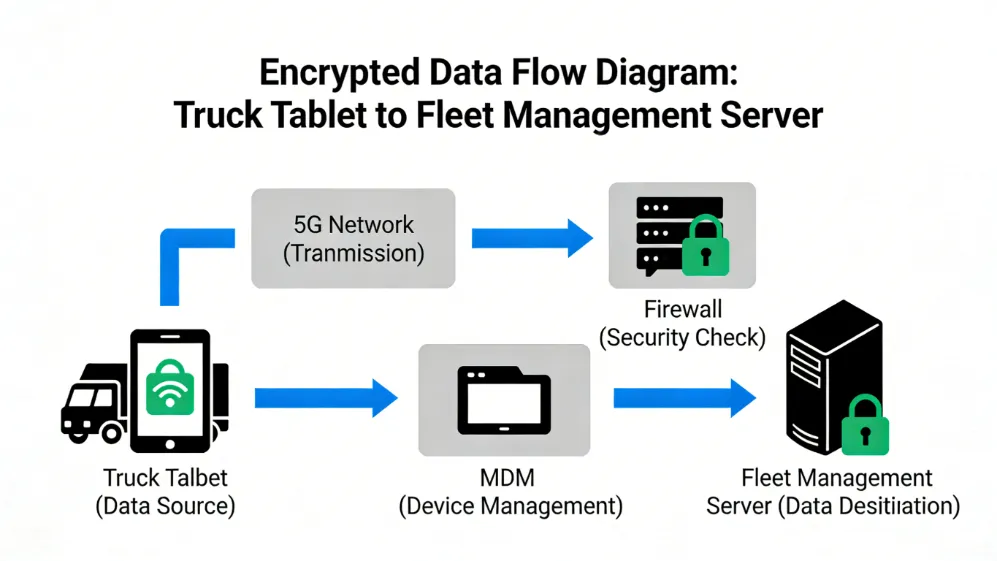
Diagram showing encrypted data flow from truck tablet through 5G network to fleet management server, highlighting firewall and MDM control points.
Compliance Requirements
- GDPR/CCPA: Ensure driver data collection complies with privacy regulations regarding location tracking.
- TSA Guidelines: For air freight fleets, ensure devices meet transportation security administration electronics standards.
- Cyber Insurance: Verify hardware security measures meet requirements for cyber liability insurance policies.


评论
发表评论