Why Choose an 8-Inch Rugged Tablet in 2026?
An 8-inch rugged tablet strikes an optimal balance between portability and functionality, making it ideal for field operations where mobility and durability are critical. Here’s why this size has become increasingly popular in industrial, construction, logistics, and emergency services sectors:

Superior Portability and Ergonomics
The 8-inch form factor is significantly lighter and more compact than 10+ inch alternatives, allowing workers to carry it comfortably for extended periods without fatigue. This makes it particularly suited for mobile roles—field technicians, delivery personnel, and emergency responders benefit from the ability to use the device one-handed while keeping the other hand free for tools or equipment. The weight and size reduction directly translates to improved productivity in high-movement environments.
Optimal Screen-to-Portability Ratio
While 7-inch tablets sacrifice screen real estate for extreme portability, and 10+ inch tablets become cumbersome for field work, 8 inches provides a “sweet spot.” The display is large enough to clearly view data-intensive applications, forms, and documentation without excessive scrolling, yet remains manageable for handheld operation. For tasks like route planning, inventory management, and equipment diagnostics, this size offers sufficient visibility without compromising mobility.
Cost-Effectiveness
8-inch rugged tablets typically cost 15-25% less than comparable 10-inch models while offering similar processing power and durability ratings. This makes them more economical for fleet deployments, where organizations need to equip multiple workers. The lower capital expenditure enables broader adoption across teams without straining IT budgets.
Ruggedness Without Compromise
Modern 8-inch rugged tablets meet the same military-grade durability standards (MIL-STD-810H) and IP ratings (IP65/IP67/IP68) as larger competitors. They withstand drops from significant heights, resist dust and water ingress, and maintain functionality in extreme temperatures—all essential for outdoor and industrial environments. The compact size actually provides structural advantages, with less surface area prone to impact damage.

Vehicle and Confined Space Compatibility
In vehicle-mounted applications (delivery trucks, field service vehicles, emergency response units), 8-inch tablets fit more naturally into dashboard mounts and confined workspaces. They’re less obstructive to driver sightlines and easier to position in tight spaces, while still providing adequate screen visibility for GPS navigation, real-time data updates, and communication systems.
Extended Battery Life
Smaller form factors typically accommodate more efficient power management. 8-inch rugged tablets commonly deliver 10-14 hours of continuous operation, sufficient for full-shift field deployment without mid-day charging. This longevity is critical for remote locations with limited power infrastructure.
Ideal for Specific Use Cases
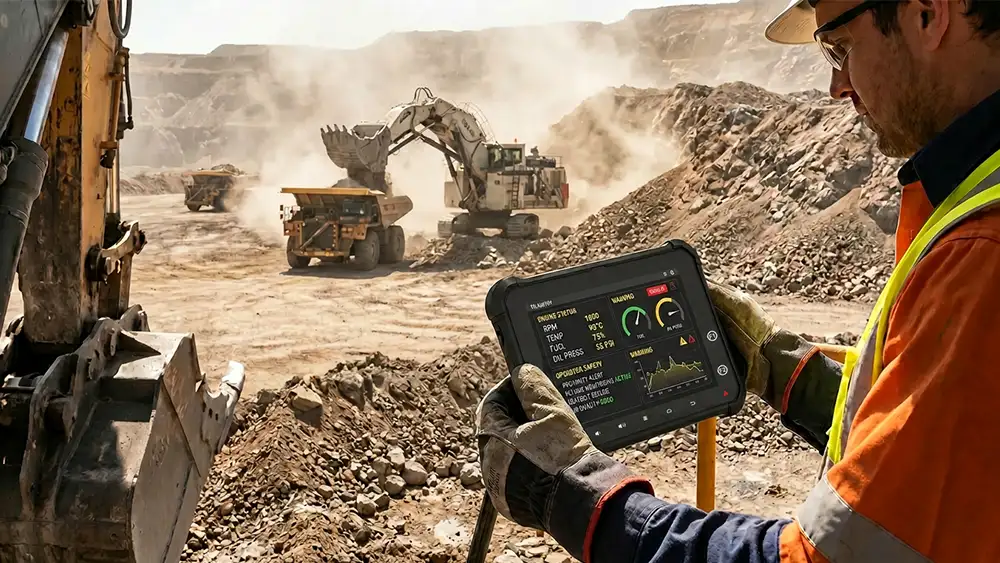
Construction & Surveying: Compact enough for one-handed data entry on job sites while maintaining durability for harsh conditions.
Logistics & Delivery: Perfect for scanning, route optimization, and proof-of-delivery workflows where mobility is paramount.
Healthcare & Emergency Services: Enables paramedics and field nurses to access patient records and protocols while maintaining portability during rapid response situations.
Manufacturing & Maintenance: Suitable for equipment diagnostics, work order management, and real-time inventory tracking on production floors.
Market Growth Recognition
The rugged tablet market is projected to grow from USD 1.2-1.45 billion in 2025 to USD 2.2-2.6 billion by 2035, with 7-9 inch tablets representing the fastest-growing segment. This expansion reflects industry recognition that the 8-inch size addresses genuine operational needs better than extreme sizes.
When 8 Inches Might Not Be Ideal
The primary limitation emerges when handling complex visual data—detailed CAD drawings, GIS mapping with fine details, or spreadsheet-heavy workflows benefit from 10+ inch screens. If stationary desktop use dominates your workflow, a larger rugged tablet becomes more practical.
Bottom line: Choose an 8-inch rugged tablet when field mobility, one-handed operation, cost efficiency, and vehicle integration outweigh the need for maximum screen real estate. For dynamic, mobile-first operations in harsh environments, it represents the most practical balance of capability and usability.


评论
发表评论